| |
| |
Caption: Board of Trustees Minutes - 1924
This is a reduced-resolution page image for fast online browsing.
EXTRACTED TEXT FROM PAGE:
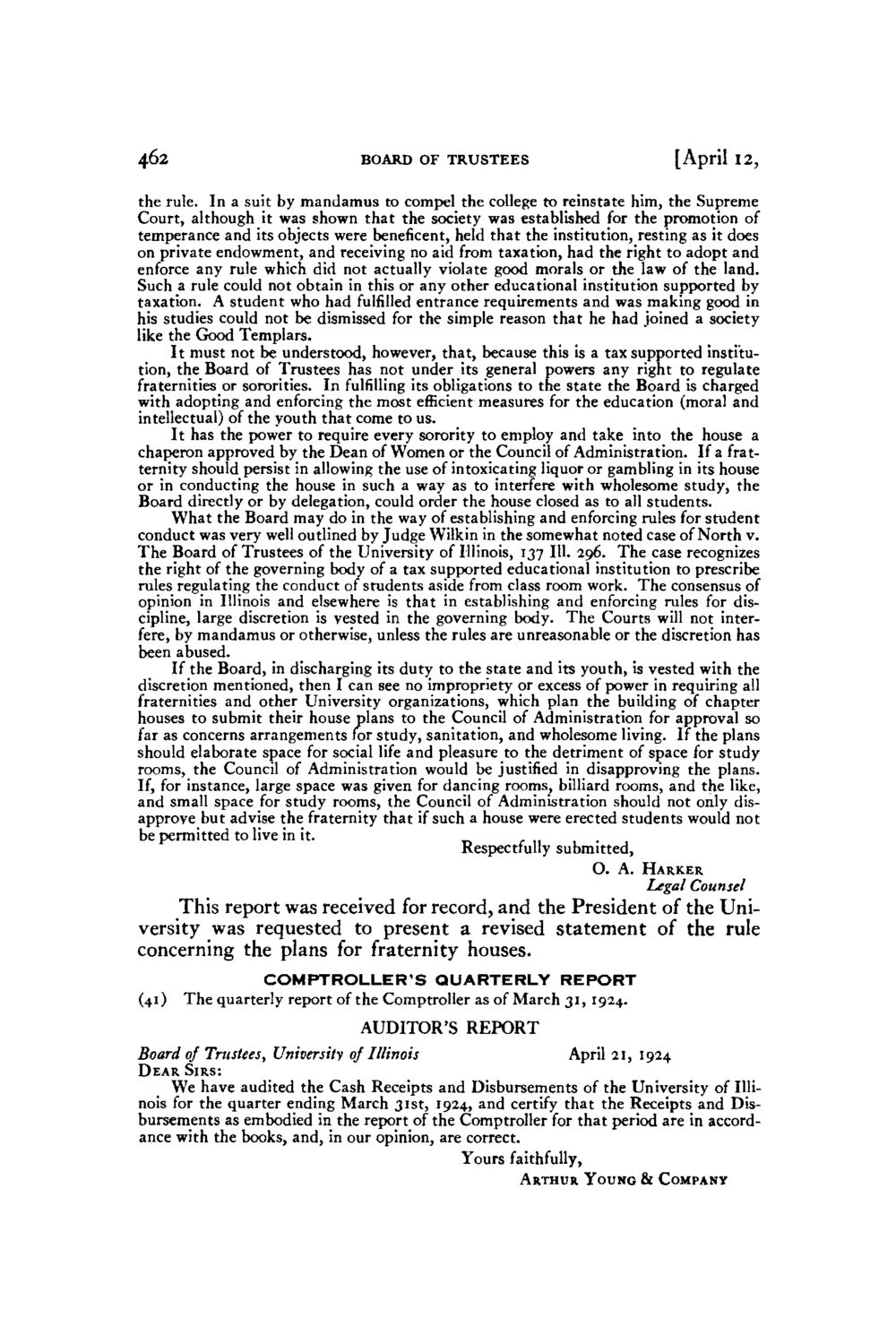
462 BOARD OF TRUSTEES [April 12, the rule. In a suit by mandamus to compel the college to reinstate him, the Supreme Court, although it was shown that the society was established for the promotion of temperance and its objects were beneficent, held that the institution, resting as it does on private endowment, and receiving no aid from taxation, had the right to adopt and enforce any rule which did not actually violate good morals or the law of the land. Such a rule could not obtain in this or any other educational institution supported by taxation. A student who had fulfilled entrance requirements and was making good in his studies could not be dismissed for the simple reason that he had joined a society like the Good Templars. It must not be understood, however, that, because this is a tax supported institution, the Board of Trustees has not under its general powers any right to regulate fraternities or sororities. In fulfilling its obligations to the state the Board is charged with adopting and enforcing the most efficient measures for the education (moral and intellectual) of the youth that come to us. It has the power to require every sorority to employ and take into the house a chaperon approved by the Dean of Women or the Council of Administration. If a fratternity should persist in allowing the use of intoxicating liquor or gambling in its house or in conducting the house in such a way as to interfere with wholesome study, the Board directly or by delegation, could order the house closed as to all students. What the Board may do in the way of establishing and enforcing rules for student conduct was very well outlined by Judge Wilkin in the somewhat noted case of North v. The Board of Trustees of the University of Illinois, 137 111. 296. The case recognizes the right of the governing body of a tax supported educational institution to prescribe rules regulating the conduct of students aside from class room work. The consensus of opinion in Illinois and elsewhere is that in establishing and enforcing rules for discipline, large discretion is vested in the governing body. The Courts will not interfere, by mandamus or otherwise, unless the rules are unreasonable or the discretion has been abused. If the Board, in discharging its duty to the state and its youth, is vested with the discretion mentioned, then I can see no impropriety or excess of power in requiring all fraternities and other University organizations, which plan the building of chapter houses to submit their house plans to the Council of Administration for approval so far as concerns arrangements for study, sanitation, and wholesome living. If the plans should elaborate space for social life and pleasure to the detriment of space for study rooms, the Council of Administration would be justified in disapproving the plans. If, for instance, large space was given for dancing rooms, billiard rooms, and the like, and small space for study rooms, the Council of Administration should not only disapprove but advise the fraternity that if such a house were erected students would not be permitted to live in it. . Respectfully submitted, O. A. Harker Legal Counsel This report was received for record, and the President of the University was requested to present a revised statement of the rule concerning the plans for fraternity houses. COMPTROLLER'S QUARTERLY REPORT (41) The quarterly report of the Comptroller as of March 31, 1924. AUDITOR'S REPORT Board of Trustees, University oj Illinois April 21, 1924 Dear Sirs: W e have audited the Cash Receipts and Disbursements of the University of Illinois for the quarter ending March 31st, 1924, and certify that the Receipts and Disbursements as embodied in the report of the Comptroller for that period are in accordance with the books, and, in our opinion, are correct. Yours faithfully,Young & Company Arthur
| |