| |
| |
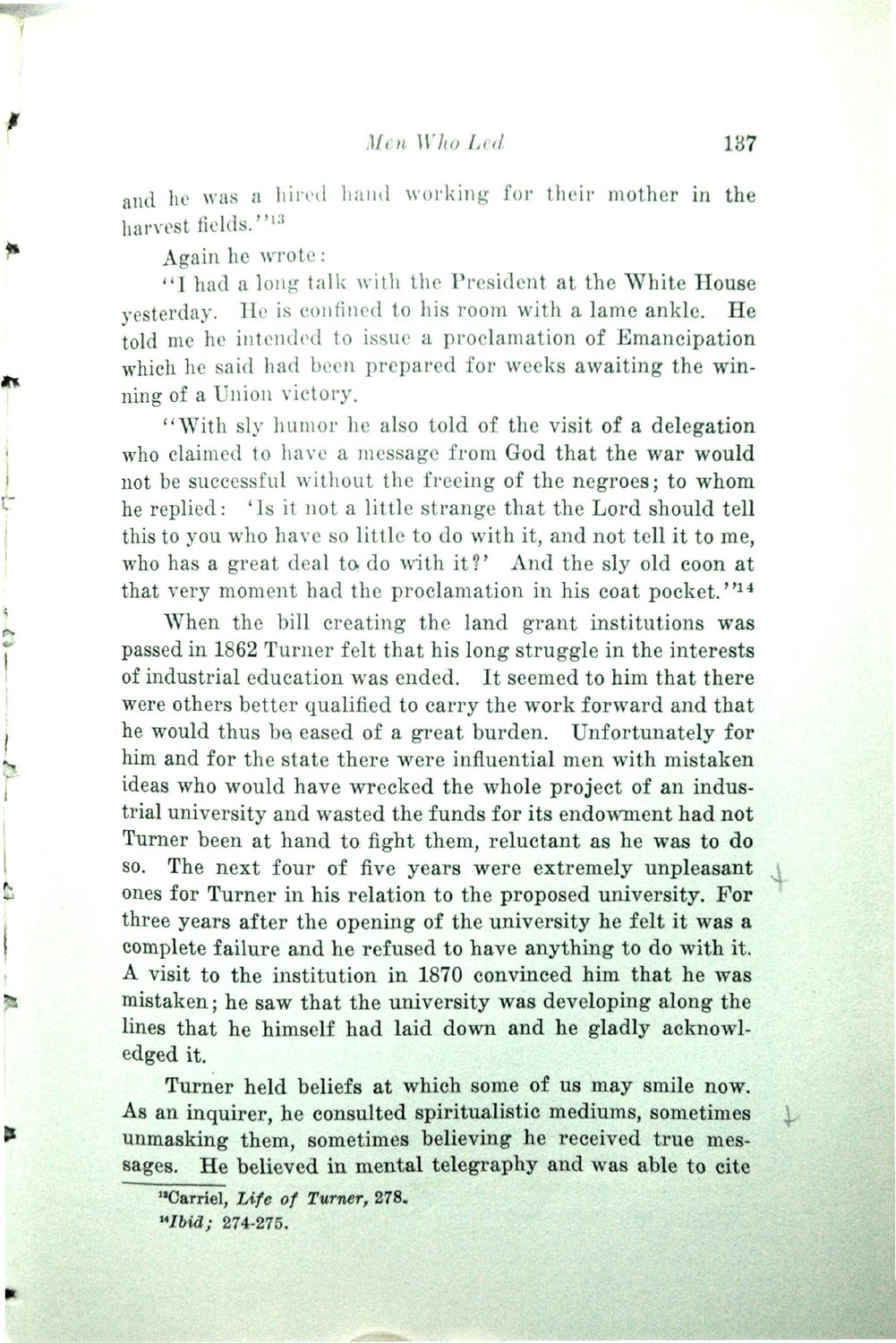
Caption: Book - History of the University (Powell)
This is a reduced-resolution page image for fast online browsing.
EXTRACTED TEXT FROM PAGE:
Men Who Led 187 and he was a hired hand working for their mother in the harvest fields."13 Again he wrote: " I had a long talk with the President at the White House yesterday. He is confined to his room with a lame ankle. He told me he intended to issue a proclamation of Emancipation which he said had been prepared for weeks awaiting the winning of a Union victory. "With sly humor he also told of the visit of a delegation who claimed to have a message from God that the war would not be successful without the freeing of the negroes; to whom he replied: 'Is it not a little strange that the Lord should tell this to you who have so little to do with it, and not tell it to me, who has a great deal tOf do with i t ? ' And the sly old coon at that very moment had the proclamation in his coat pocket." 14 When the bill creating the land grant institutions was passed in 1862 Turner felt that his long struggle in the interests of industrial education was ended. It seemed to him that there were others better qualified to carry the work forward and that he would thus bei eased of a great burden. Unfortunately for him and for the state there were influential men with mistaken ideas who would have wrecked the whole project of an industrial university and wasted the funds for its endowment had not Turner been at hand to: fight them, reluctant as he was to do so. The next four of five years were extremely unpleasant ones for Turner in his relation to the proposed university. For three years after the opening of the university he felt it was a complete failure and he refused to have anything to do with it. A visit to the institution in 1870 convinced him that he was mistaken; he saw that the university was developing along the lines that he himself had laid down and he gladly acknowledged it. Turner held beliefs at which some of us may smile now. As an inquirer, he consulted spiritualistic mediums, sometimes unmasking them, sometimes believing he received true messages. He believed in mental telegraphy and was able to cite '•Carriel, Life of Turner, 278. u Ibid: 274-275.
| |