| |
| |
Caption: War Publications - WWI Compilation 1923 - Article 20
This is a reduced-resolution page image for fast online browsing.
EXTRACTED TEXT FROM PAGE:
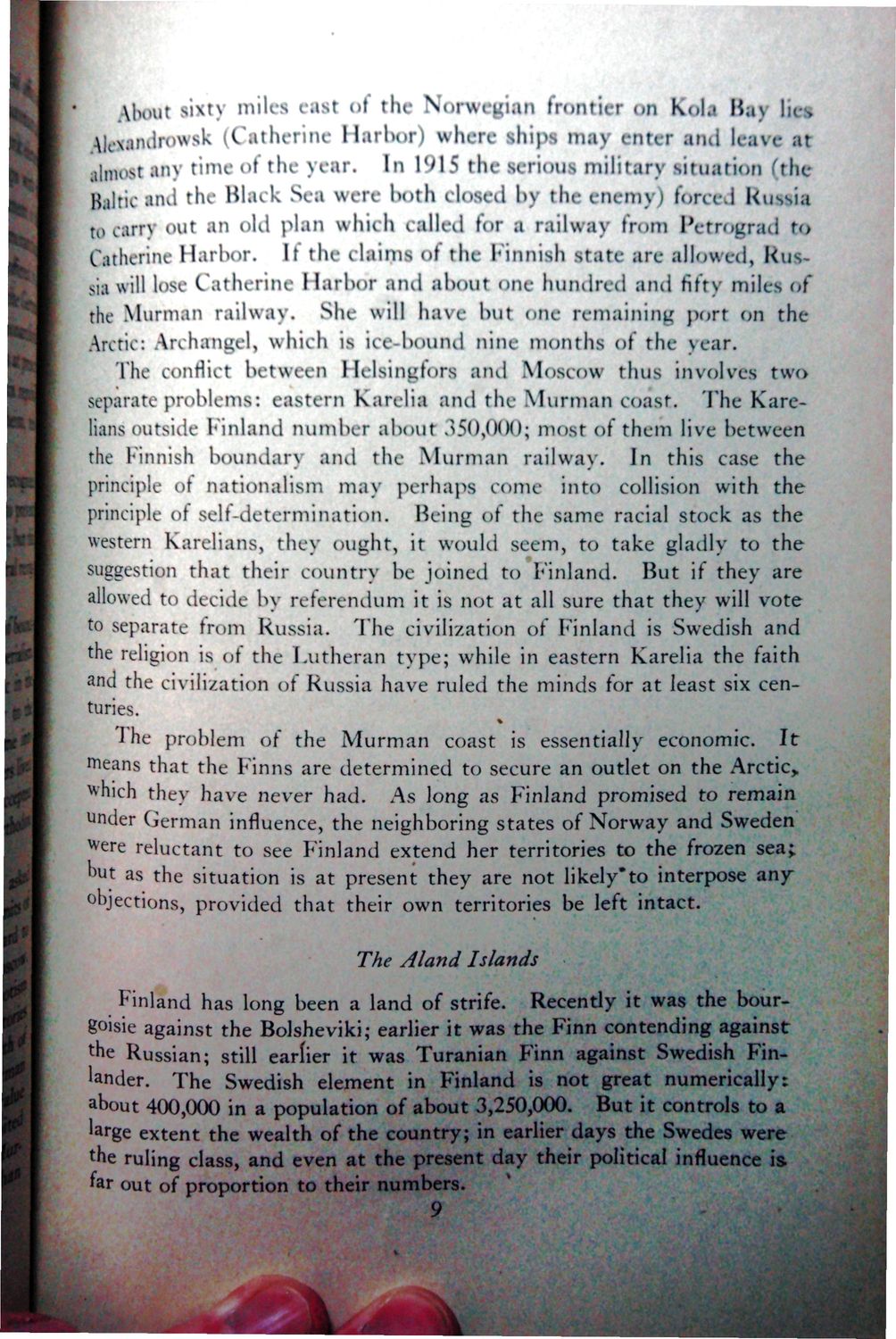
the Norwegian frontier (C a|nu»t eave at any time of the year. In 1915 the serious military situation (the Baltic ami the Hlack Sea were both closed by the enemy) forced Russia out an an w m to earn ° ^ P^ ' ' * called for a railway from Petrograd to Catherine Harbor. If the claims of ( IK Finnish state are allowed, Russia will lose Catherine Harbor and about one hundred and fifty miles of the Murman railway. She will have but one remaining port on the Arctic: Archangel, which is ice-bound nine months of the year. The conflict between I lelsinufors and Moscow thus involves two separate problems: eastern Karelia and the Murman coast. The KareHans outside Finland number about ^50,000; most of them live between the Finnish boundary and the Murman railway. In this case the principle < t nationalism may perhaps come into collision with the > principle of self-determination. Being of the same racial stock as the western Karelians, they ought, it would seem, to take gladly to the suggestion that their country be joined to Finland. But if they are allowed to decide by referendum it is not at all sure that they will vote to separate from Russia. The civilization of Finland is Swedish and the religion is of the Lutheran type; while in eastern Karelia the faith and the civilization of Russia have ruled the minds for at least six centuries. Ihe problem of the Murman coast is essentially economic. I t means that the Finns are determined to secure an outlet on the Arctic,. which they have never had. As long as Finland promised to remain under German influence, the neighboring states of Norway and Sweden were reluctant to see Finland extend her territories to the frozen sea; terpose Ejections, provided that their own territories be left intact. V 1 # The Aland Islands Finland has long been a land of strife. Recently it was the bourgoisie against the Bolsheviki; earlier it was the Finn contending against the Russian; still earlier it was Turanian Finn against Swedish Finlander. The Swedish element in Finland is not great numerically: about 400,000 in a population of about 3,250,000. But it controls to a large extent the wealth of the country; in earlier days the Swedes were the ruling class, and even at the present day their pol far out of proportion to their numbers. 9
| |