| |
| |
Caption: War Publications - WWI Compilation 1923 - Article 20
This is a reduced-resolution page image for fast online browsing.
EXTRACTED TEXT FROM PAGE:
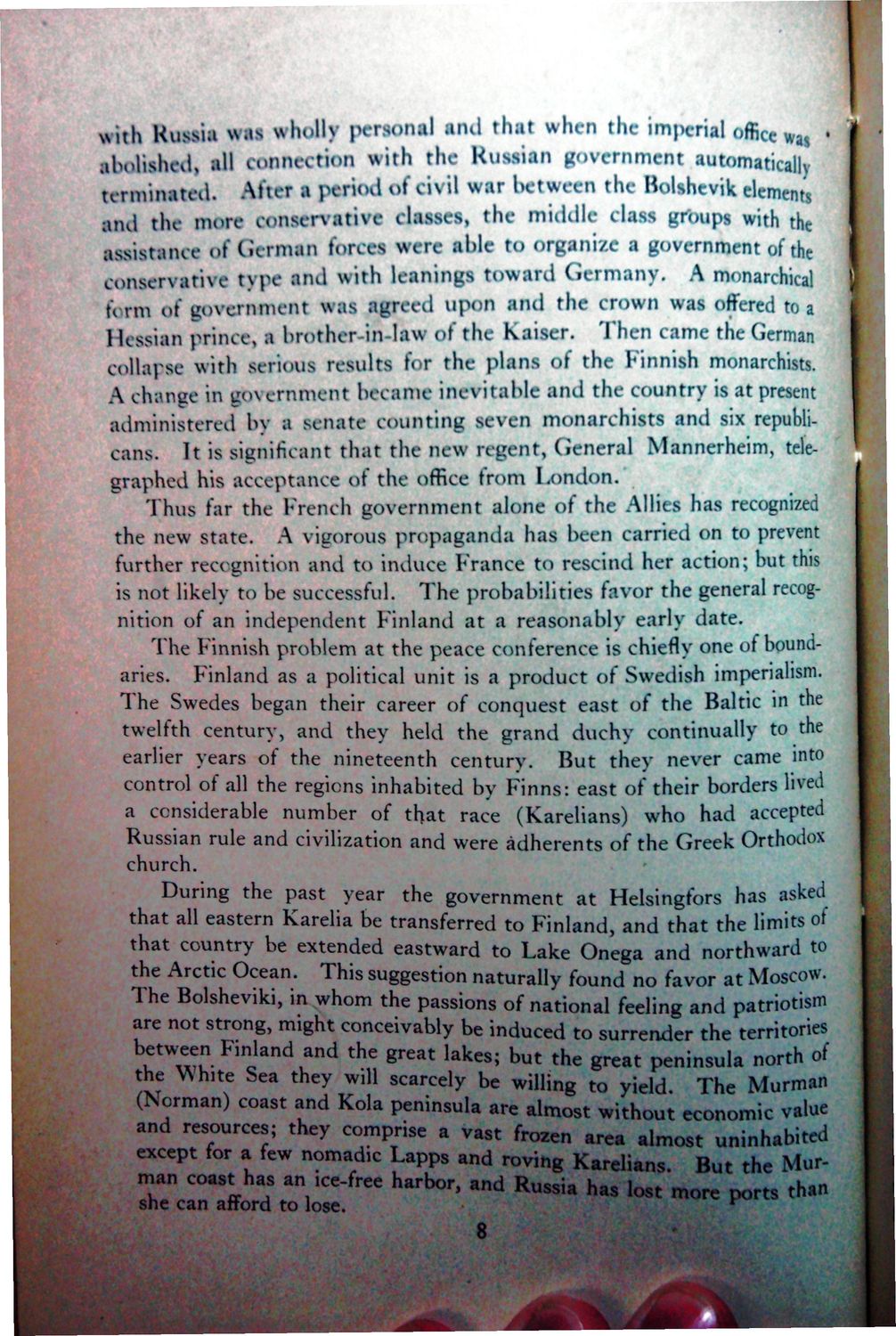
* with Russia w u wholly personal ami that when the imperial office w»$ • abolished, all connection with the Russian government automatically terminated. A t e I period of civil war between the Bolshevik elements and the more conservative chines, the middle class groups with the assistance < t ( H I man forces were able to organize a government of the > conservative type and with leanings toward Germany. A monarchical term of government was agreed upon and the crown was offered to a 1 lessian prince, a brother-in-law of the Kaiser. Then came the German collapse with serious results for the plans of the A change in go\ eminent became inevitable and the country is at present administered bv a senate counting seven monarchists and six republicans. It is significant that the new regent, General Mannerhcim, telegraphed his acceptance of the office from London. Thus far the French government alone of the Allies has recognized the new state. A vigorous propaganda has been carried on to prevent further recognition and to induce France to rescind her action; but this is not likely to be successful. The probabilities favor the general recognition of an independent Finland at a reasonably early date. The Finnish problem at the peace conference is chiefly one of boundaries. Finland as a political unit is a product of Swedish imperialism. The Swedes began their career of conquest east of the Baltic in the twelfth century, and they held the grand duchy continually to the earlier years of the nineteenth century. But they never came into control of all the regions inhabited by Finns; east of their borders lived a considerable number of that race (Karelians) who had accepted Russian rule and civilization and were adherents of the Greek Orthodox church. During the past year the government at Helsingfors has asked that all eastern Karelia be transferred to Finland, and that the limits of that country be extended eastward to Lake Onega and northward to the Arctic Ocean. This suggestion naturally found no favor at Moscow. The Bolsheviki, in whom the passions of national feeling and patriotism are not strong, might conceivably be induced to surrender the territories between Finland and the great lakes; but the great peninsula north of the White Sea they will scarcely be willing to yield. The Murman (Norman) coast and Kola peninsula are almost without economic value and resources; they comprise a vast frozen area almost uninhabited except for a few nomadic Lapps and roving Karelians. Murports she can afford to lose. 8
| |