| |
| |
Caption: War Publications - WWI Compilation 1923 - Article 20
This is a reduced-resolution page image for fast online browsing.
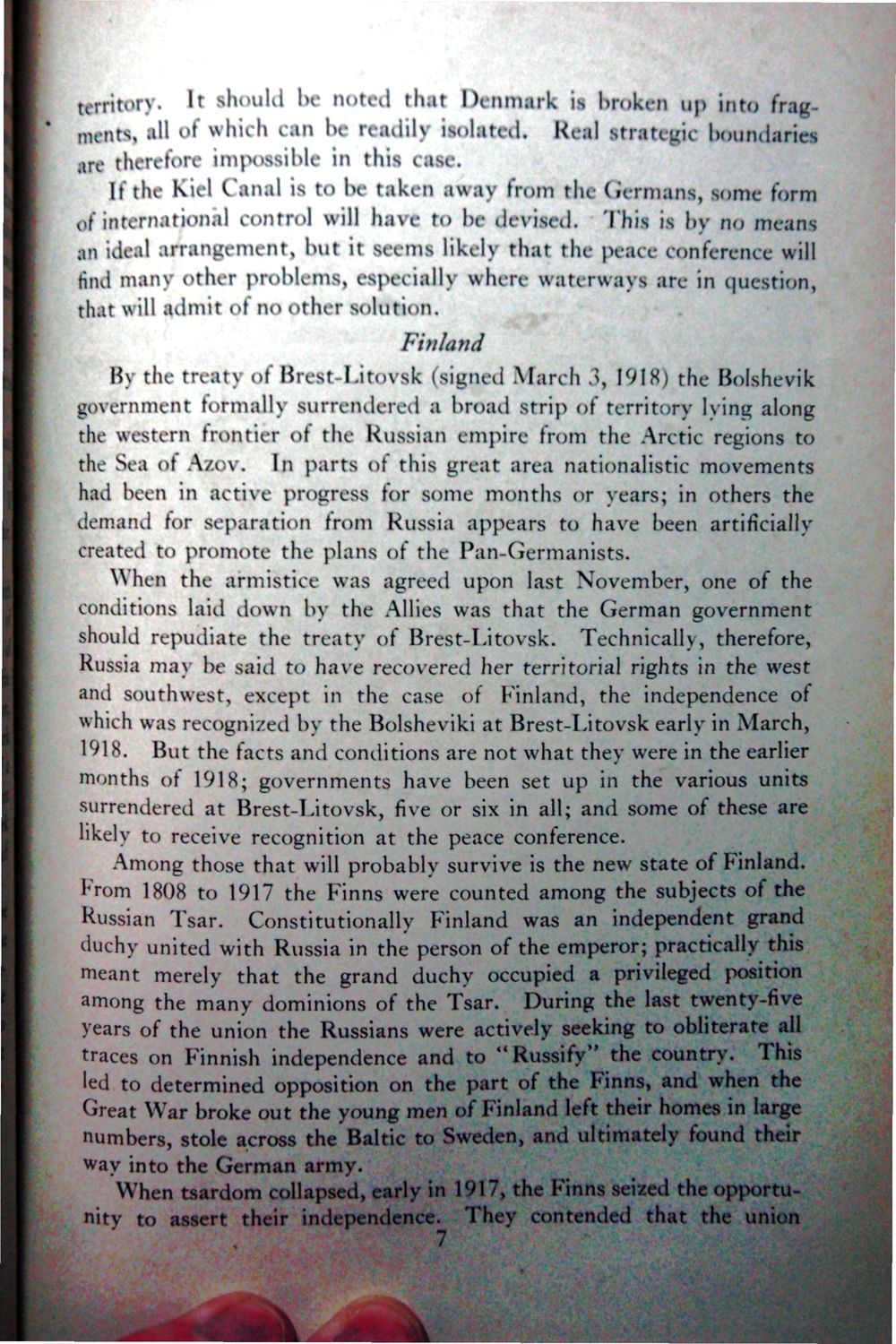
EXTRACTED TEXT FROM PAGE:
territory. It should be noted that Denmark is broken up into fragments all of which can be readily isolated. Krai strategic boundaries are therefore impossible in this case. If the Kiel Canal is to be taken away from the Germans, some form of international control will have to be devised. This is by no means an ideal arrangement, but it seems likely that the peace conference will find many Other problems, especially where waterways are in question, that will *dmit of no other solution. Finland By the treaty of Brest-Litovsk (signed March 3, 1918) the Bolshevik government formally surrendered a broad strip of territory lying along the western frontier of the Russian empire from the Aretie regions to the Sea ot Azov. In parts of this great area nationalistic movements had been in active progress for some months or years; in others the demand tor separation from Russia appears to have been artificially created to promote the plans of the Pan-Germanists. When the armistice was agreed upon last November, one of the conditions laid down by the Allies was that the German government should repudiate the treaty of Brest-Litovsk. Technically, therefore, Russia may be said to have recovered her territorial rights in the west and southwest, except in the case of Finland, the independence of which was recognized by the Bolshevik] at Brest-Litovsk early in March, 1918. But the facts and conditions are not what they were in the earlier months of 1918; governments have been set up in the various units surrendered at Brest-Litovsk, five or six in all; and some of these are likely to receive recognition at the peace conference. Among those that will probably survive is the new state of Finland. From 1808 to 1917 the Finns were counted among the subjects of the Russian Tsar. Constitutionally Finland was an independent grand duchy united with Russia in the person of the emperor; practically this meant merely that the grand duchy occupied a privileged position among the many dominions of the Tsar. During the last twenty-five years of the union the Russians were actively seeking to obliterate all traces on Finnish independence and to "Russify" the country. This led to determined opposition on the part of the Finns, and when the Great War broke out the young men of Finland left their homes in large numbers, stole across the Baltic to Sweden, and ultimately found their way into the German army. When tsardom collapsed, early in 1917, the Finns seized the opportunity to assert their independence. They contended that the union
| |