| |
| |
Caption: War Publications - WWI Compilation 1923 - Article 20
This is a reduced-resolution page image for fast online browsing.
EXTRACTED TEXT FROM PAGE:
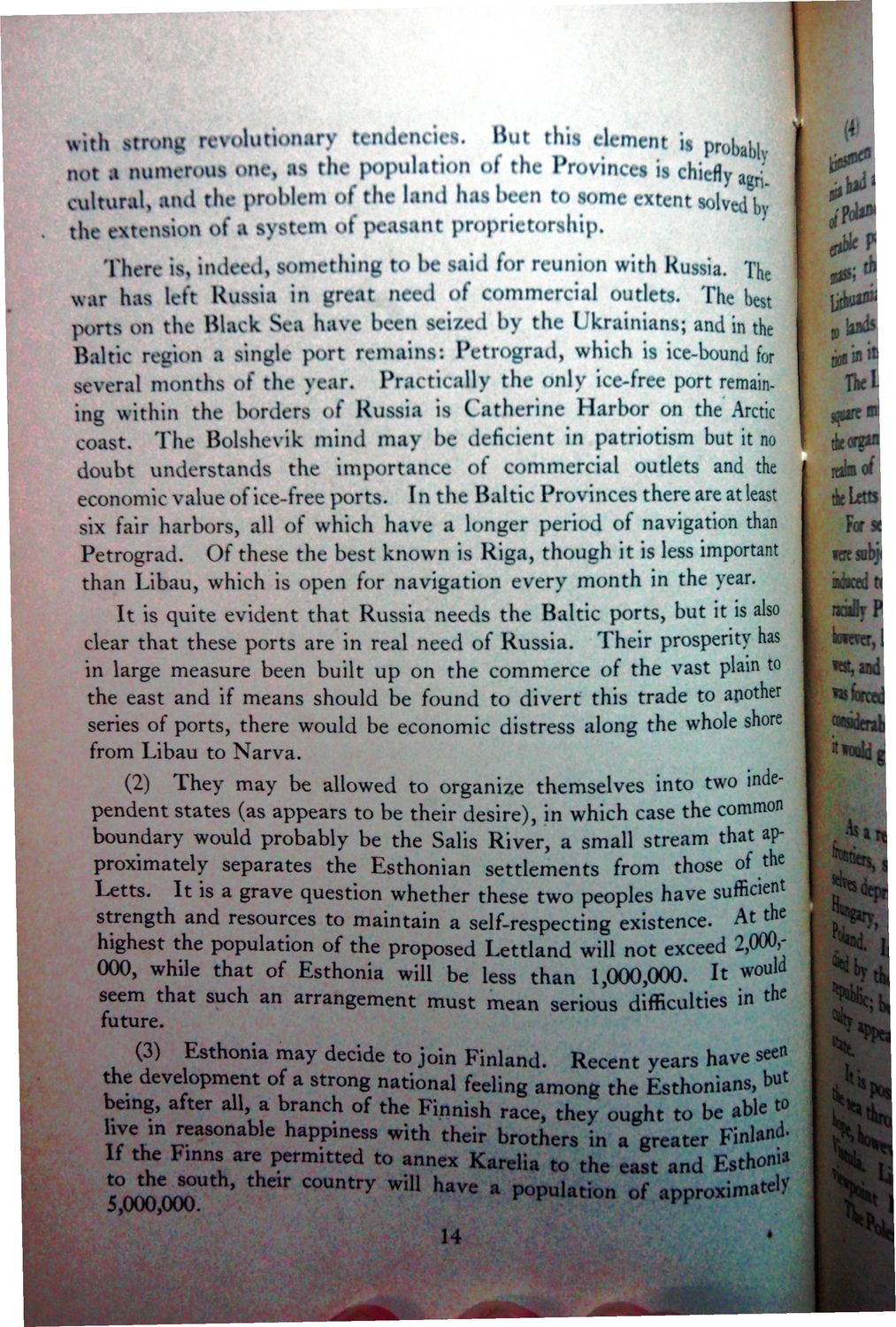
itionary tendencies. Hut this element is pro|,ai ie, as the population of the Provinces is chiefly y not a nu toUem of the land has been to some extent soiv«i extension of a system of peasant tor The war has left Russia in great need of commercial outlets. The best ports on the Black Sea have been seized by the Ukrainians; and in the hich is ice-bo or several months of the year. Practically the only ice-free port ing within the borders of Russia is Catherine Harbor on the Arctiic coast. The Bolshevik mind may be deficient in patriotism but it no doubt understands the importance of commercial outlets and the economic value of ice-free ports. In the Baltic Provinces there are at least six fair harbors, all of which have a longer period of navigation th Petrograd. Of these the best known is Riga, though it is less important than Libau, which is open for navigation every month in the year. It is quite evident that Russia needs the Baltic ports, but it is also clear that these ports are in real need of Russia. Their prosperity has in large measure been built up on the commerce of the vast plain to the east and if means should be found to divert this trade to another series of ports, there would be economic distress along the whole shore from Libau to Narva. (2) They may be allowed to organize themselves into two independent states (as appears to be their desire), in which case the common boundary would probably be the Salis River, a small stream that approximately separates the Esthonian settlements from those of the Letts. It is a grave question whether these two peoples have sufficient strength and resources to maintain a self-respecting existence. At the highest the population of the nmnncpH T ~++\anA -A\\ n o t exceed 2,000,000 ,000,000. It would seem that such an arrangement must mean serious difficulties in the future. (3) Esthonia may decide to join Finland. Recent years have seen the development of a strong national feeling among the Esthonians, but bemg, after all, a branch of the Finnish race, they ought to be able to n e a s o n a b l e ha TJV ' PPiness with their brothers in a greater FinlandIf the Finns are permitted to annex Karelia to the east and Esthonia C U n t r y WiU h a V e a ? ™ ™ ' ° P o P ^ ^ m of approximately 14
| |