| |
| |
Caption: War Publications - WWI Compilation 1923 - Article 20
This is a reduced-resolution page image for fast online browsing.
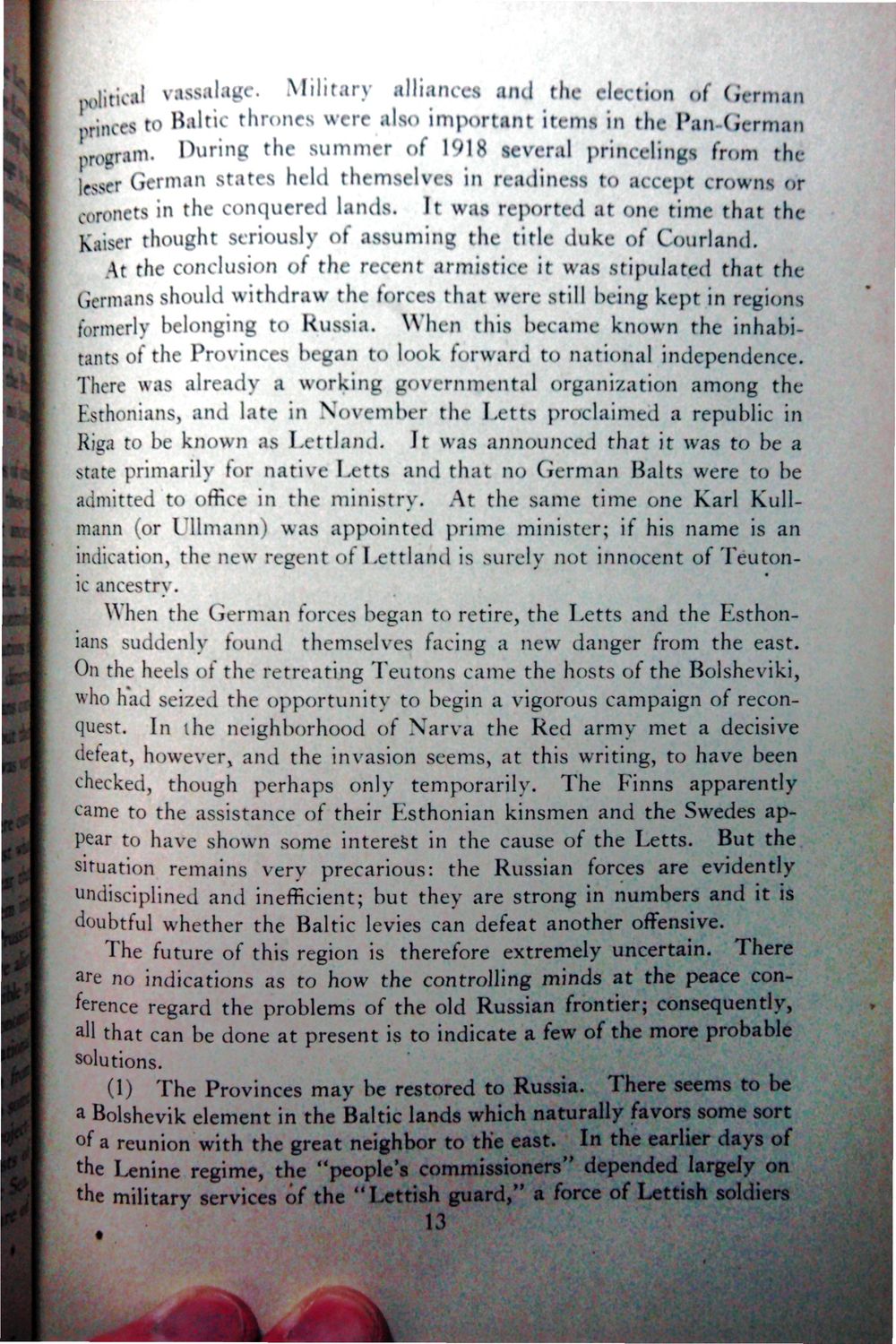
EXTRACTED TEXT FROM PAGE:
political vassalage. Military alliances .md the election of German princes to Baltic thrones were also important items in the Pan (icrman program. During the summer of 1918 several princelings from the lfSSer German states held themselves in readiness to accept crowns or coronets in the conquered lands. It was reported at one time that the Kaiser thought seriously of assuming the title duke of Courland. At the conclusion of the recent armistice it was stipulated that the Germans should withdraw the forces that were still being kept in regions formerly belonging to kussia. When this became known the inhabitants of the Provinces began to look forward to national independence. There was already a working governmental organization among the Esthonians, and late in November the Letts proclaimed a republic in as be state primarily for native Letts and that no German Halts were to be admitted to office in the ministry. At the same time one Karl Kullniann (or I'llmann) was appointed prime minister; if his name is an indication, the new regent of Lettland is surely not innocent of Teutonic ancestry. When the German forces began to retire, the Letts and the Esthonians suddenly found themselves facing a new danger from the east. On the heels of the retreating Teutons came the hosts of the Bolsheviki, who had seized the opportunity to begin a vigorous campaign of reconquest. In the neighborhood of Narva the Red army met a decisive defeat, however, and the invasion seems, at this writing, to have been checked, though perhaps only temporarily. The Finns apparently came to the assistance of their Ksthonian kinsmen and the Swedes appear to have shown some interest in the cause of the Letts. But the, situation remains very precarious: the Russian forces are evidently undisciplined and inefficient; but they are strong in numbers and it is doubtful whether the Baltic levies can defeat another offensive. The future of this region is therefore extremely uncertain. There are no indications as to how the controlling minds at the peace conference regard the problems of the old Russian frontier; consequently, a ll that can be done at present is to indicate a few of the more probable solutions. (1) The Provinces may be restored to Russia. There seems to be a Bolshevik element in the Baltic lands which naturally favors some sort °f a reunion with the great neighbor to the east. In the earlier days of " depended largely on Le u services of the Lettish guard," a force of Lett • 13 '•'• it. • WM
| |