| |
| |
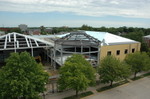
Caption: Dedication - Natural Resources
This is a reduced-resolution page image for fast online browsing.
EXTRACTED TEXT FROM PAGE:
materials. Illinois clay is in the red bricks that form the wa of the Georgian structure. Illinois white oak is in the doors a the panel trim of offices and laboratories. Warm gray Jolj tri dolomite, from Illinois, forms the walls of the lobby, Illinois clay is in the terra cotta that lines the laboratory walls. Sand for the mortar between the bricks, sand for the plaster on office walls, and aggregate for the concrete of piers, foundation walls, and floors are all part of the rich and varied natural resources of Illinois. Basic to the conception of the building was the efficient utilization of every cubic foot of space. T h e basement with its well-lighted laboratories, the next three floors with their offices and laboratories, and the fourth with its libraries, offices, laboratories and storage rooms, have all been planned for efficient use. Even the large chimneys, a characteristic of Georgian architecture, are functional in that they serve as outlets for the numerous chemical hoods in the laboratories throughout the building. Except on the first floor, piping is readily accessible to allow for reorientation of the scientific programs requiring new or improved laboratories and to permit repair and maintenance of service lines without destruction of walls. Only on the first floor has deviation from the utilitarian been permitted. Here the citizen of Illinois who comes to inquire about the oil, coal, agricultural products, fishes, trees, o r other natural resources of his state, finds himself in a lobby of warm gray Joliet dolomite in which have been set exhibit cases displaying the natural resources of the State and the results of scientific investigations relating to them. Bas-reliefs, silver and gold in color, emblematic of Illinois resources and the work of the Geological and Natural History Surveys, decorate the walls. In the halls and offices, harmonious pastel colors predominate. With completion of the first unit of the Natural Resources Building, increased facilities have been provided for the employment of modern science in developing and conserving the State's renewable and non-renewable natural resources for the benefit of all its citizens. All laboratories a r e directly serviced with distilled water, steam, vacuum and compressed air, electric current of various voltages and much special equipment for a wide range of research. Machine shops have been equipped for the construction of specialized research apparatus not available in the open market. Each laboratory is tailor-made for the P*&eE£$kt
| |