| |
| |
Caption: Course Catalog - 1893-1894
This is a reduced-resolution page image for fast online browsing.
EXTRACTED TEXT FROM PAGE:
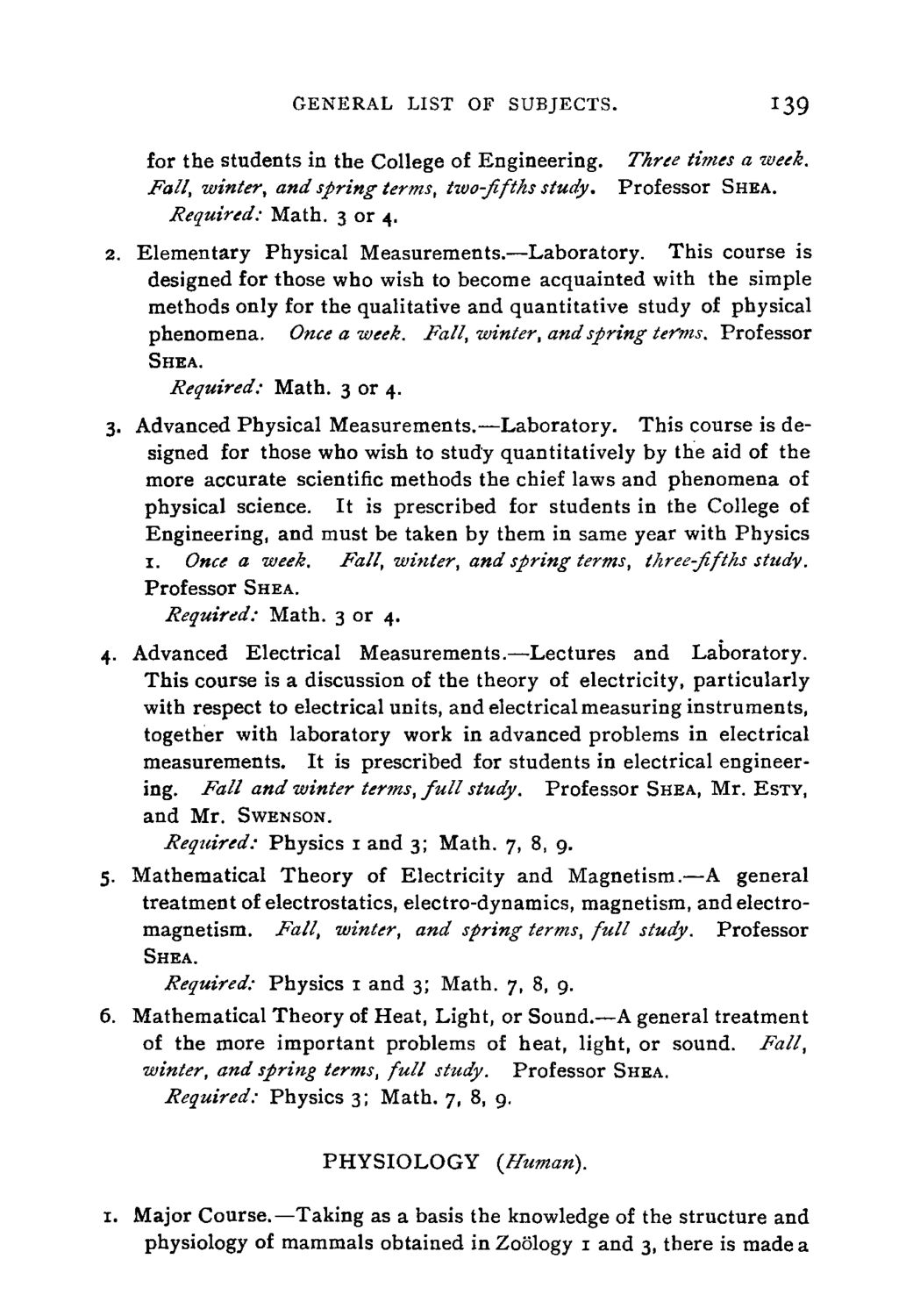
GENERAL LIST OF SUBJECTS. 139 for the students in the College of Engineering. Three times a week. Fall, winter, and spring terms, two-fifths study. Professor SHEA. Required: Math. 3 or 4. 2. Elementary Physical Measurements.—Laboratory. This course is designed for those who wish to become acquainted with the simple methods only for the qualitative and quantitative study of physical phenomena. Once a week. Fall, winter, and spring terms. Professor SHEA. Required: Math. 3 or 4. 3. Advanced Physical Measurements.—Laboratory. This course is designed for those who wish to study quantitatively by the aid of the more accurate scientific methods the chief laws and phenomena of physical science. It is prescribed for students in the College of Engineering, and must be taken by them in same year with Physics 1. Once a week. Fall, winter, and spring terms, three-fifths study. Professor SHEA. Required: Math. 3 or 4. 4. Advanced Electrical Measurements.—Lectures and Laboratory. This course is a discussion of the theory of electricity, particularly with respect to electrical units, and electrical measuring instruments, together with laboratory work in advanced problems in electrical measurements. It is prescribed for students in electrical engineering. Fall and winter terms, full study. Professor SHEA, Mr. ESTY, and Mr. SWENSON. Required: Physics 1 and 3; Math. 7, 8, 9. 5. Mathematical Theory of Electricity and Magnetism.—A general treatment of electrostatics, electro-dynamics, magnetism, and electromagnetism. Fall, winter, and spring terms, full study. Professor SHEA. Required: Physics 1 and 3; Math. 7, 8, 9. 6. Mathematical Theory of Heat, Light, or Sound.—A general treatment of the more important problems of heat, light, or sound. Fall, winter, and spring terms, full study. Professor SHEA. Required: Physics 3; Math. 7, 8, 9. PHYSIOLOGY (Human). 1. Major Course.—Taking as a basis the knowledge of the structure and physiology of mammals obtained in Zoology 1 and 3, there is made a
| |